What Makes a Gemstone Valuable?
A Practical, Real-World Explanation
Many people assume a gemstone is valuable because:
- It looks beautiful
- It is rare
- It is expensive
- Someone said it’s “powerful”
In reality, gemstone value is built on a few very specific factors — and beauty alone is only one part of the picture.
Let’s break this down simply and honestly.
-
Natural Origin (The Foundation of Value)
The most basic question is:
Is the gemstone natural or synthetic?
- Natural gemstones are formed in the earth over millions of years
- Synthetic gemstones are lab-created and far less valuable
A natural gemstone — even if modest — will always hold more long-term value than a perfect-looking synthetic stone.
Natural origin is non-negotiable for real value.
-
Treatment Status (Untreated > Treated)
Not all treatments are equal.
- Untreated / no heat → highest value
- Minor, stable treatments → moderate value
- Heavy treatments (glass filling, diffusion, irradiation) → low value
Two stones can look identical — but the untreated one can be worth many times more.
Why?
Because untreated stones preserve nature’s original structure.
-
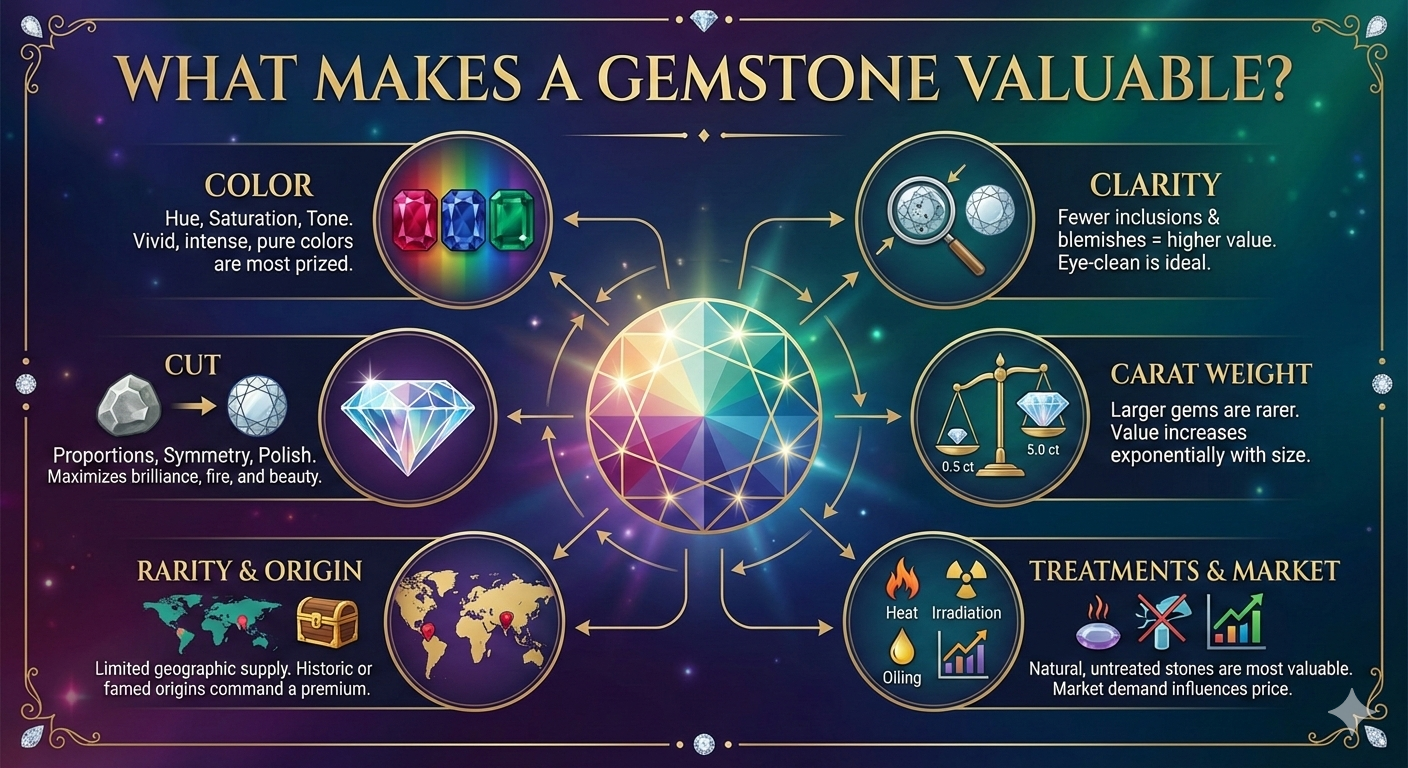
Colour (The Biggest Visual Driver of Value)
Colour matters more than size in many gemstones.
Value depends on:
- Hue (the actual colour)
- Tone (light vs dark)
- Saturation (intensity, not brightness)
Examples:
- A smaller, vivid Blue Sapphire (नीलम) can be more valuable than a larger dull one
- A rich green Emerald (पन्ना) often outranks a pale but larger stone
In gemstones, better colour beats bigger size.
-
Clarity (But Not the Diamond Standard)
Clarity means internal inclusions — but gemstones are judged differently from diamonds.
Important points:
- Some inclusions are natural and acceptable
- In emeralds, inclusions are expected
- Eye-clean stones usually command higher value
Perfect clarity is rare in coloured gemstones — and sometimes suspicious.
Natural inclusions do not automatically reduce value.
-
Cut & Shape (Value vs Waste Balance)
Cut is about:
- Symmetry
- Proportions
- Light return
- Weight retention
A well-cut gemstone:
- Looks brighter
- Shows colour evenly
- Feels balanced
But unlike diamonds, gemstone cutters often prioritise preserving weight over ideal brilliance — especially in rare stones.
Good cut adds value.
Over-polishing can destroy it.
-
Size (Carat Weight) — Important, But Not Alone
Size does matter — but only after quality.
- Large gemstones with poor colour are common
- Large gemstones with top colour are rare
This is why:
- A 3-carat fine ruby can be worth more than a 10-carat average one
Value grows exponentially, not linearly, with size — only when quality is high.
-
Origin (Context, Not Magic)
Some origins are historically prized:
Origin can:
- Add prestige
- Increase collector interest
- Raise auction value
But origin does not override quality.
A mediocre stone from a famous origin is still mediocre.
-
Certification & Transparency
A gemstone becomes more valuable when:
- It is tested by a recognised lab
- Treatments are clearly disclosed
- The buyer knows exactly what they are getting
Certification builds trust, not beauty.
A stone with honest disclosure is more valuable than one with mystery.
-
Demand & Market Reality
Value is also shaped by:
- Cultural demand
- Fashion cycles
- Astrological relevance
- Regional preferences
For example:
- Yellow Sapphire (पुखराज) has strong demand in India
- Emerald (पन्ना) is prized for business and education
- Blue Sapphire (नीलम) carries both respect and caution
Demand doesn’t change quality — but it affects price.
-
Purpose: Why You Are Buying the Gemstone
This is often overlooked.
A gemstone bought for:
- Astrology
- Daily wear
- Collection
- Investment
- Jewellery
…will be valued differently in each case.
The “most expensive” stone is not always the most suitable one.
The Most Important Truth About Gemstone Value
A gemstone is valuable when its quality, honesty, and purpose are aligned.
Not when it is hyped.
Not when it is fear-sold.
Not when it is compared blindly.
Final Perspective
Gemstone value is built on:
- Nature
- Integrity
- Rarity
- Quality
- Suitability
When these come together, value becomes obvious — even without explanation.
One Line to Remember
A gemstone’s true value lies not in its price tag, but in how honestly nature, quality, and purpose come together.